If your energy bills keep climbing despite upgrading your HVAC system, the real culprit might be hiding in your walls, ceiling, and floor — not your equipment. The thermal envelope of a building is, in many ways, the single most influential factor determining how hard your heating and cooling systems have to work. Yet most homeowners and even some contractors treat it as an afterthought.
That’s a costly mistake.
Let me explain what the thermal envelope actually is, why it matters more than most people realize, and how specific components within it can make or break the energy efficiency of any building.
What Is a Thermal Envelope?
The thermal envelope — sometimes called the building envelope — refers to the physical boundary that separates a building’s conditioned interior space from the unconditioned exterior environment. Think of it as the skin of your home. Every wall assembly, roof structure, floor slab, window frame, and door system that exists at the perimeter of your conditioned space is part of this envelope.
Its core function is simple: resist the unwanted transfer of heat. In winter, you want to keep heat in. In summer, you want to keep heat out. How effectively your building does both of those things determines how often your HVAC system runs, how much energy it consumes, and ultimately, how comfortable your home or building feels throughout the year.
A well-designed thermal envelope doesn’t eliminate the need for mechanical heating and cooling — it reduces the load placed on those systems dramatically. That distinction is critical.
The Science Behind Heat Transfer
To understand why the thermal envelope matters so much, you first need to understand the three mechanisms through which heat moves:
Conduction happens when heat travels directly through solid materials — from the warm side of a wall to the cooler side. Insulation resists this process.
Convection occurs when heated air circulates and carries thermal energy with it. Air leaks in the building envelope allow conditioned air to escape and unconditioned air to infiltrate, which forces your system to compensate constantly.
Radiation is the transfer of heat through electromagnetic waves — the most familiar example being sunlight warming a surface through a window. Low-emissivity coatings on glazing address this specific pathway.
A building with a compromised thermal envelope loses or gains heat through all three of these channels simultaneously. The result is that even an oversized, high-efficiency HVAC system cannot fully compensate for an envelope that is riddled with thermal bridges, air gaps, or under-insulated assemblies.
Core Components and Their Impact on Efficiency
Let me walk through each major component of the thermal envelope and explain how each one directly affects heating and cooling performance.
1. Roof and Attic Assembly
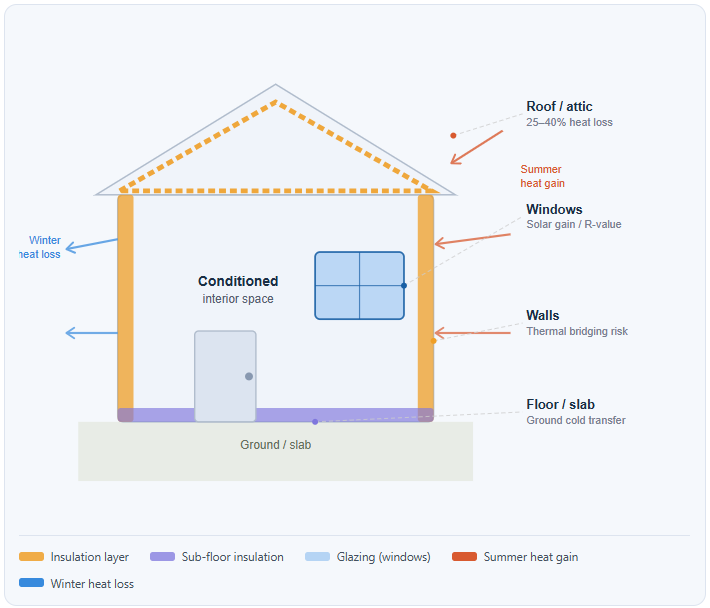
The roof accounts for the largest share of heat transfer in most residential and commercial buildings—typically 25%-40% of total heat loss in winter and an even greater share of unwanted heat gain in summer. This is partly physics (hot air rises) and partly geometry (the roof has the greatest exposure to direct sunlight).
Attic insulation with an R-value that matches your climate zone is non-negotiable. In colder climates, such as much of the northern United States and Canada, current best practices recommend attic insulation of R-49 to R-60. In warmer southern climates, the focus shifts toward radiant barriers and reflective insulation to deflect solar radiation before it conducts downward into the living space.
A poorly insulated attic turns into what building scientists call a “heat sink” in summer — absorbing solar energy all day and radiating it into your living space well into the night. Your air conditioning system ends up fighting the building itself.
2. Wall Assemblies and Thermal Bridging
Walls represent roughly 15–25% of a typical building’s heat loss, but their complexity lies in what’s called thermal bridging. Even when stud cavities are filled with fiberglass batt insulation, the wooden or steel studs themselves conduct heat at a far faster rate than the insulation around them. In a standard 2×6 stud wall with R-19 cavity insulation, the effective whole-wall R-value often drops to R-14 or lower because of this bridging effect.
Continuous insulation installed on the exterior of the sheathing — whether rigid foam or mineral wool board — is the most effective solution. It interrupts the thermal bridge entirely, dramatically improving whole-wall performance without requiring exotic construction methods.
3. Fenestration — Windows and Doors
Windows are the most thermally complex component of any building envelope. A single-pane window has an effective R-value of roughly R-1. A code-minimum double-pane unit gets you to approximately R-2. High-performance triple-pane windows with low-e coatings and argon or krypton gas fills can achieve R-7 to R-12 — a meaningful difference.
But raw R-value tells only part of the story for glazing. The Solar Heat Gain Coefficient (SHGC) determines how much solar radiation passes through the glass as usable heat energy. In passive solar design, south-facing windows with a high SHGC are intentional — they capture free solar heat in winter. In hot climates, a low SHGC on west- and east-facing windows is essential to prevent solar gain from overwhelming the cooling system.
Door assemblies are frequently overlooked. A standard hollow-core interior door used as an exterior door — which happens in older buildings more than you’d think — has an effective insulating value close to zero. Insulated fiberglass and steel exterior doors typically deliver R-5 to R-7, and every air gap around the frame compounds the problem significantly.
4. Air Sealing — The Silent Efficiency Killer
This is where most buildings fall dramatically short, and it’s the area with the greatest return on investment. Air leakage — the uncontrolled movement of air through gaps, cracks, penetrations, and poorly detailed assemblies — can account for 25% to 40% of a building’s total heating and cooling load, according to research from the U.S. Department of Energy.
Every penetration through the envelope — electrical outlets, plumbing, recessed lights, duct boots, attic hatches — is a potential infiltration point. In older homes built before modern air sealing standards, the cumulative effect of these leaks is the equivalent of leaving a window open around the clock, every day of the year.
Blower door testing quantifies air leakage in terms of ACH50 (air changes per hour at 50 pascals of pressure). A typical older American home might measure 10–15 ACH50. A well-built modern home targets 3 ACH50 or better. Passive House certified buildings achieve 0.6 ACH50 or below — and their mechanical systems are proportionally smaller as a result.
5. Below-Grade and Foundation Assemblies
Foundations and slab floors are the most commonly neglected part of the thermal envelope. Ground temperature is relatively stable year-round — typically 45–60°F in most temperate climates — but that stability works against you when interior spaces are heated above 70°F. Heat conducts continuously downward into the earth without proper insulation below and around the slab.
For basement walls, continuous interior or exterior rigid foam insulation is the standard recommendation. For slab-on-grade construction, sub-slab insulation — typically R-10 minimum — prevents the ground from acting as a constant heat sink beneath your flooring.
How Thermal Envelope Quality Directly Affects Mechanical System Sizing
One of the most important — and most frequently misunderstood — relationships in building performance is the connection between the thermal envelope and mechanical system sizing. HVAC equipment is sized based on a Manual J load calculation, which accounts for the rate at which a building gains or loses heat under design conditions.
A building with a high-performance thermal envelope has a dramatically smaller design load. This means:
- Smaller HVAC equipment is required, reducing capital cost
- The equipment operates in longer, steadier cycles rather than short bursts, improving efficiency and extending equipment life
- Humidity control improves because longer run cycles allow more moisture removal
- The building maintains comfort without temperature swings, even during equipment downtime or power interruptions
In contrast, a building with a poor thermal envelope creates what engineers call a “high-load” environment. Systems are oversized to compensate; they constantly short-cycle, and the owner ends up paying both higher utility bills and higher maintenance costs indefinitely.
Real-World Performance: What the Numbers Show
The performance gap between buildings with strong and weak thermal envelopes is not marginal — it’s substantial.
Research from the Rocky Mountain Institute has documented that high-performance buildings with superior thermal envelopes consume 60–80% less energy for heating and cooling compared to buildings built to minimum code standards. Passive House buildings — the most rigorous envelope-first standard in use today — routinely demonstrate heating energy use of just 15 kBtu per square foot per year, compared to 50–100+ kBtu/sq.ft. for conventionally built homes in similar climates.
A retrofit case study from the Building Science Corporation found that air sealing and insulation upgrades alone — without replacing the HVAC system — reduced heating energy consumption by 35% in an older New England colonial-style home. The payback period for the retrofit was under six years.
The Thermal Envelope in Hot Climates vs. Cold Climates
The emphasis of envelope design shifts based on climate. In cold climates (ASHRAE Climate Zones 5–8), the priority is reducing conductive heat loss — higher R-values in all assemblies, aggressive air sealing, and triple-pane glazing on north-facing exposures.
In hot-humid and hot-dry climates (Zones 1–3), the priorities reorder. Radiant barriers in attic assemblies, low-SHGC glazing on east and west exposures, and deep roof overhangs to shade walls become critical. Moisture management also gains urgency — a tight envelope in a hot-humid climate must be carefully vapor-managed to avoid trapping condensation within assemblies.
Mixed climates (Zones 4–5) require the most sophisticated design because the envelope must perform well under both heating and cooling conditions. This is where variable permeability materials, enthalpy recovery ventilation, and careful window orientation decisions pay the greatest dividends.
Common Thermal Envelope Deficiencies and How to Identify Them
Infrared thermography is the most effective diagnostic tool for evaluating thermal envelope performance. A certified thermographer can identify missing insulation, thermal bridges, and air leakage pathways that are completely invisible to the naked eye. The optimal time for this assessment is when the temperature differential between interior and exterior is at least 18°F.
Energy bills that spike disproportionately during heating and cooling seasons — especially when compared to neighbors with similar square footage — often indicate envelope deficiencies rather than equipment inefficiency.
Comfort complaints in specific zones — one room that never gets warm, or a corner bedroom that’s always too hot in summer — frequently trace back to localized envelope problems rather than duct or equipment issues.
Condensation on interior window surfaces during winter indicates that window surface temperatures are dropping below the dew point of interior air — a sign that glazing performance is insufficient for the climate.
What to Prioritize When Improving Your Thermal Envelope
If you’re planning improvements, the sequencing matters enormously. Here’s the order that delivers the highest return:
First: Air sealing. It’s low-cost, high-impact, and creates the foundation for everything else. Without it, even excellent insulation underperforms because air moves around and through it.
Second: Attic and roof insulation. The largest surface area with the greatest temperature differential drives the most heat loss and gain. Every dollar spent here returns measurable results.
Third: Wall insulation improvements. Continuous exterior insulation is the gold standard for existing buildings. Interior insulation deepening is viable in gut renovations.
Fourth: Window and door upgrades. High-performance glazing is expensive but particularly impactful on south and west elevations in most climates. Don’t replace windows before sealing air leaks — the sequencing matters.
Fifth: Below-grade and foundation insulation. Critical in cold climates, often overlooked, and difficult to retrofit in occupied buildings. Address it during any major renovation that exposes the foundation.
Summary
Your HVAC system is only as efficient as the building it’s trying to condition. A state-of-the-art heat pump or high-SEER air conditioner will still run constantly — and expensively — if the thermal envelope it’s working within leaks heat freely.
The thermal envelope is not just an architectural feature. It is the primary energy management system of every building. Get it right, and mechanical systems become smaller, cheaper, and longer-lived. Get it wrong, and no amount of equipment efficiency will compensate for the energy you’re hemorrhaging through walls, attics, windows, and floors every hour of every day.
For homeowners, commercial building owners, and developers alike, investing in envelope performance is not a luxury upgrade — it’s the most durable, highest-return energy decision available in construction and renovation.