If you’ve been researching ways to slash your energy bills and reduce your carbon footprint, you’ve almost certainly come across geothermal HVAC systems. They sound almost too good to be true — heat your home using the earth’s natural temperature, cut your utility costs by up to 70%, and enjoy a system that outlasts most HVAC options on the market. But then you see the price tag, and the excitement fades fast.
Here’s the thing most people don’t hear: the upfront cost to install geothermal HVAC tells only half the story. When you factor in long-term energy savings, federal tax credits, and the system’s exceptional lifespan, the financial picture shifts dramatically. This guide breaks down everything — real numbers, real factors, and real-world advice — so you can make a confident, well-informed decision.
What Does It Cost to Install a Geothermal HVAC System in 2026?
Let’s start with the number everyone wants to know. The cost to install geothermal HVAC in 2026 typically falls between $15,000 and $50,000 for most residential projects, with a national average landing around $20,000 to $27,000. On the lower end, smaller homes with favorable soil conditions and horizontal loop systems might come in closer to $12,000 to $15,000. On the higher end, large homes, rocky terrain, or vertical drilling requirements can push costs well past $50,000 — sometimes reaching $75,000 or more for premium installations.
Below is a quick snapshot of where your investment is likely to land depending on your home size:
| Home Size | Estimated System Size | Estimated Total Cost |
|---|---|---|
| Small home (1,000–1,500 sq ft) | 2–2.5 tons | $12,000 – $22,000 |
| Medium home (1,500–2,500 sq ft) | 3–4 tons | $18,000 – $35,000 |
| Large home (2,500–4,000 sq ft) | 4–5 tons | $28,000 – $50,000 |
| Very large home (4,000+ sq ft) | 5+ tons | $40,000 – $75,000+ |
These figures include equipment, ground loop installation, labor, and basic permitting. They do not yet account for potential tax credits or rebates — which we’ll cover in detail below.
What Makes Up the Total Cost?
Understanding the cost to install geothermal HVAC requires looking at each component separately. No two installations are identical, and knowing what drives costs up — or keeps them down — puts you in a much stronger position when collecting contractor quotes.
1. The Heat Pump Unit
The indoor heat pump unit is the heart of your system, and its cost scales directly with your home’s heating and cooling needs. Heat pumps are rated in tons — one ton equals 12,000 BTUs of capacity — and most homes require between 2 and 5 tons. Expect to pay roughly $2,500 to $8,000 per ton for the unit alone. That means the equipment cost for an average 3-ton system runs between $7,500 and $14,000 before installation labor.
2. Ground Loop Installation — The Biggest Variable
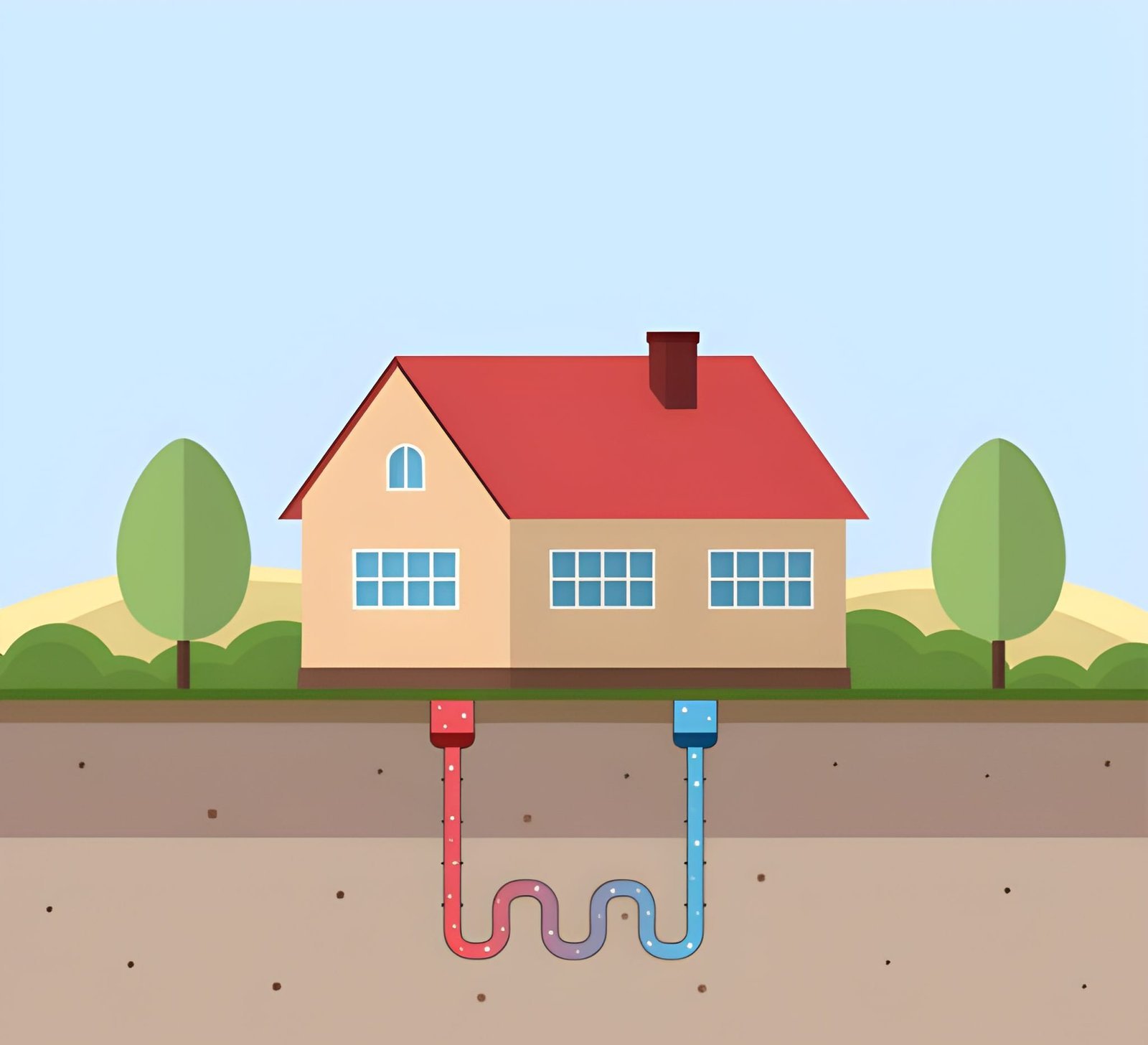
This is where geothermal costs diverge most dramatically from traditional HVAC. The ground loop is the underground piping network that exchanges heat with the earth, and installing it is labor-intensive and equipment-heavy. Ground loop installation typically accounts for 50% to 70% of your total project cost. There are three primary loop configurations, each with different cost implications:
- Horizontal loops: Require wide trenches at 4 to 6 feet deep. Less expensive because no deep drilling is needed, but demands a large yard — typically 1,200 to 1,800 square feet of open land. Costs range from $5,000 to $10,000 for most installations.
- Vertical loops: Require drilling boreholes 150 to 400 feet deep. More expensive but takes up minimal yard space. Ideal for suburban lots. Drilling costs alone often run $8,000 to $20,000 or more, depending on depth and soil composition.
- Pond or lake loops: If you have a suitable body of water on your property, this can be the most affordable loop option, often costing $5,000 to $8,000 — though site-specific conditions heavily influence final pricing.
3. Labor and System Design
Geothermal installation is highly specialized work. Contractors must evaluate your property’s soil conditions, water table, climate, and home load requirements before designing a system. This expertise commands premium rates compared to standard HVAC installation. Labor costs, including excavation crews, HVAC technicians, and project management, typically range from $5,000 to $15,000, depending on system complexity and your local market.
4. Ductwork Modifications
If your home already has an existing, well-maintained duct system, you’ll likely be able to connect your new geothermal heat pump without major modifications. However, if your ducts are undersized, poorly insulated, or improperly laid out, expect to budget an additional $1,400 to $5,600 for ductwork upgrades. Homes without any existing ductwork that need a full installation from scratch can add $8,000 to $15,000 to the total project cost.
5. Permits and Inspections
Most jurisdictions require permits for geothermal installations, particularly for any drilling activity or open-loop systems that interact with groundwater. Permit fees typically range from $50 to $2,000, depending on your municipality and the scope of work. Some areas with strict environmental regulations around groundwater can add considerable permitting time and costs, so it’s worth checking with your local building department before committing to a timeline.
6. Landscaping Restoration
After horizontal trenching or vertical drilling, your yard will need some repair. This often means re-seeding grass, restoring flower beds, or relocating sprinkler systems. Budget $500 to $3,000 for landscaping restoration, depending on how much excavation is required and the current state of your yard.
7. Electrical Upgrades
Older homes sometimes require electrical panel upgrades or rewiring to accommodate the power demands of a geothermal heat pump. If your electrical system is outdated, factor in an additional $1,000 to $5,000 for necessary upgrades. A qualified electrician can assess your panel during the initial consultation phase.
Key Factors That Directly Influence Your Installation Cost
Home size and heating/cooling load: Larger homes need bigger systems, which means more capacity, more ground loop footage, and higher overall costs. A Manual J load calculation — performed by your contractor — determines the precise system size required and prevents you from overpaying for more capacity than you need.
Geographic location: Labor rates vary significantly by region. Urban markets in the Northeast or West Coast tend to cost more than rural Midwest installations. Your location also determines soil conditions: clay-rich soil transfers heat more efficiently than dry, sandy soil, potentially reducing the loop footage required.
Soil and terrain conditions: Rocky ground, high water tables, or limited equipment access can dramatically increase excavation costs. An experienced installer will conduct soil testing before providing a final quote — be cautious of any contractor who skips this step.
New construction vs. retrofit: Installing geothermal in a newly built home is generally 20% to 40% less expensive than retrofitting an existing home. Open walls make ductwork easier, and excavation won’t disrupt established landscaping or existing utility lines.
System brand and efficiency ratings: Premium brands with higher Coefficient of Performance (COP) ratings — a measure of heating efficiency — command higher equipment prices. However, a more efficient system can shorten your payback period through greater energy savings. Look for units with a COP of 4.0 or higher and an EER rating above 20 for cooling.
Tax Credits, Incentives, and How They Reduce Your Real Out-of-Pocket Cost
Here’s where the financial case for geothermal HVAC gets genuinely compelling. If you installed a qualifying geothermal heat pump by December 31, 2025, you were eligible for the federal Section 25D Residential Clean Energy Tax Credit, which covered 30% of your total installation cost with no dollar cap. On a $25,000 installation, that translates to a $7,500 reduction in your federal tax liability — a substantial offset against the upfront investment.
Important update for 2026: The One Big Beautiful Bill Act, enacted in July 2025, ended the Section 25D residential clean energy credit for systems placed in service after December 31, 2025. If you’ve already installed your system, you can still claim the credit on your 2025 tax return using IRS Form 5695. If you’re planning a new installation in 2026, the federal residential credit is no longer available — making it essential to explore state and local incentives.
For commercial geothermal projects, the picture is different. Commercial installations can still qualify for the Investment Tax Credit (ITC) under Section 48, which offers a base credit of 30% with potential bonus credits for prevailing wage compliance, domestic content requirements, or location in designated energy communities — potentially reaching up to 60%.
Beyond federal programs, many states offer their own incentives. New York, for example, provides a 25% state tax credit for geothermal installations. Utility companies in many regions offer rebates as well. The Database of State Incentives for Renewables and Efficiency (DSIRE) is the best resource for finding current state and local programs in your area.
Geothermal vs. Traditional HVAC: How Do the Numbers Stack Up?
The sticker shock of geothermal is real. A conventional gas furnace and central air conditioning combo averages around $7,000 to $12,000 installed — a fraction of geothermal’s upfront cost. So why do tens of thousands of homeowners make the switch every year? The answer lies in operating costs and system longevity. Consider a typical 2,000-square-foot home:
| Factor | Geothermal HVAC | Conventional HVAC |
|---|---|---|
| Average install cost | $20,000 – $35,000 | $7,000 – $12,000 |
| Monthly energy cost (heating/cooling) | $50 – $150 | $150 – $350+ |
| Annual maintenance cost | $100 – $250 | $300 – $600 |
| Lifespan (indoor unit) | 20–25 years | 10–15 years |
| Lifespan (ground loop) | 50+ years | N/A |
| Energy savings vs. conventional | Up to 70% annually | Baseline |
| Typical payback period | 8–15 years | N/A |
The math is stark: if a geothermal system saves you $2,000 per year in energy costs compared to conventional heating and cooling, a $25,000 system pays for itself in roughly 12 to 13 years. Given the indoor unit’s 20+ year lifespan and the ground loop’s 50+ year service life, you’re looking at decades of lower energy costs after the break-even point.
Understanding Geothermal System Types and Their Cost Implications
Closed-Loop Systems
Closed-loop systems circulate a refrigerant-and-antifreeze mixture through sealed underground pipes. They are the most common residential choice and are available in horizontal, vertical, and pond configurations. Because the fluid never directly contacts groundwater, these systems have fewer environmental permitting requirements. Most residential installations use closed-loop systems.
Open-Loop Systems
Open-loop systems draw groundwater from a well, extract heat energy from it, and discharge the water back into the ground or a surface drainage area. They can be more efficient than closed-loop systems in areas with abundant groundwater, and they’re often less expensive to install. However, they require access to a suitable water supply and may face stricter environmental regulations in some jurisdictions. Water quality testing is essential before choosing this option.
Is Geothermal HVAC Worth the Investment?
This is the question every homeowner asks, and the answer genuinely depends on your specific situation. Geothermal makes the most financial sense when several conditions align:
- You plan to stay in your home for 10 or more years, giving the system time to pay back its upfront cost through energy savings.
- Your current heating fuel is expensive — propane, oil, or electric resistance heating offers the greatest savings potential when switching to geothermal.
- Your property has the space and soil conditions to support a horizontal or vertical loop without excessive excavation costs.
- You’re building new construction, where installation costs are lower, and there’s no disruption to existing landscaping.
- You value long-term reliability and low maintenance — geothermal systems have far fewer mechanical components exposed to the elements than conventional systems.
There’s also the home value consideration. Research consistently shows that energy-efficient homes command premium prices at resale. Homes with modern, high-efficiency HVAC systems typically sell for around 2.7% more than comparable properties — a meaningful uplift when applied to the average home price.
How to Find a Qualified Geothermal Installer and Get an Accurate Quote
The quality of your installation matters just as much as the quality of your equipment. A poorly designed or improperly installed geothermal system won’t deliver the efficiency gains you’re paying for. Here’s how to approach the contractor selection process:
- Get at least three detailed quotes from licensed, insured geothermal contractors — not just general HVAC companies claiming geothermal experience.
- Ask for references from recent geothermal installations in your area and follow up with those homeowners about their actual energy savings.
- Confirm the contractor will perform a Manual J load calculation to properly size your system, and ask to review the soil testing report before work begins.
- Verify certifications with industry organizations such as the International Ground Source Heat Pump Association (IGSHPA) or the Geothermal Exchange Organization (GEO).
- Review the quote in detail — make sure it itemizes equipment, ground loop installation, labor, permits, and landscaping restoration separately so you can compare contractors on equal footing.
- Ask about warranty coverage for both the heat pump unit and the ground loop, and confirm what post-installation service and maintenance agreements are available.
Ongoing Operating Costs: What to Expect After Installation
One of the most compelling aspects of geothermal HVAC is its low cost of ownership after installation. Monthly energy costs for heating and cooling a well-insulated 2,000-square-foot home with a properly sized geothermal system typically run $50 to $150 — compared to $200 to $400 or more for conventional systems in regions with cold winters.
Annual maintenance is similarly modest. An annual professional inspection costs approximately $100 to $250 and involves checking refrigerant levels, verifying loop pressure, cleaning air filters, and inspecting the heat pump’s mechanical components. Unlike furnaces and air conditioners, geothermal systems have no outdoor components exposed to weather, freeze-thaw cycles, or UV degradation — which dramatically reduces wear and tear over time.
If repairs are ever needed, indoor heat pump components typically cost $200 to $1,500 to repair, depending on the issue. The ground loop itself is virtually maintenance-free and carries warranties of 25 to 50 years from most reputable manufacturers.
Summary
The cost to install geothermal HVAC — typically $15,000 to $50,000 for residential projects — is undeniably higher than conventional alternatives. But framing that number in isolation misses the broader financial reality. When you account for decades of reduced energy bills, minimal maintenance costs, exceptional system longevity, and the improved resale value of your home, geothermal heating and cooling emerges as one of the most financially sound home improvements available to homeowners with suitable properties.
The decision comes down to your timeline, your property’s characteristics, and your current energy costs. For most homeowners planning to stay in their home for a decade or more — especially those currently heating with oil, propane, or electric resistance — geothermal HVAC delivers a compelling return on investment along with daily comfort that conventional systems simply can’t match.
The smartest next step is to schedule consultations with two or three certified geothermal installers in your area, have your property assessed, and get detailed quotes that reflect your home’s specific needs. The numbers may surprise you — in a very good way.